
Palatal Expanders in Yukon, OK: How They Work and Who Needs One
 Marlo A Miller DDS Marketing on
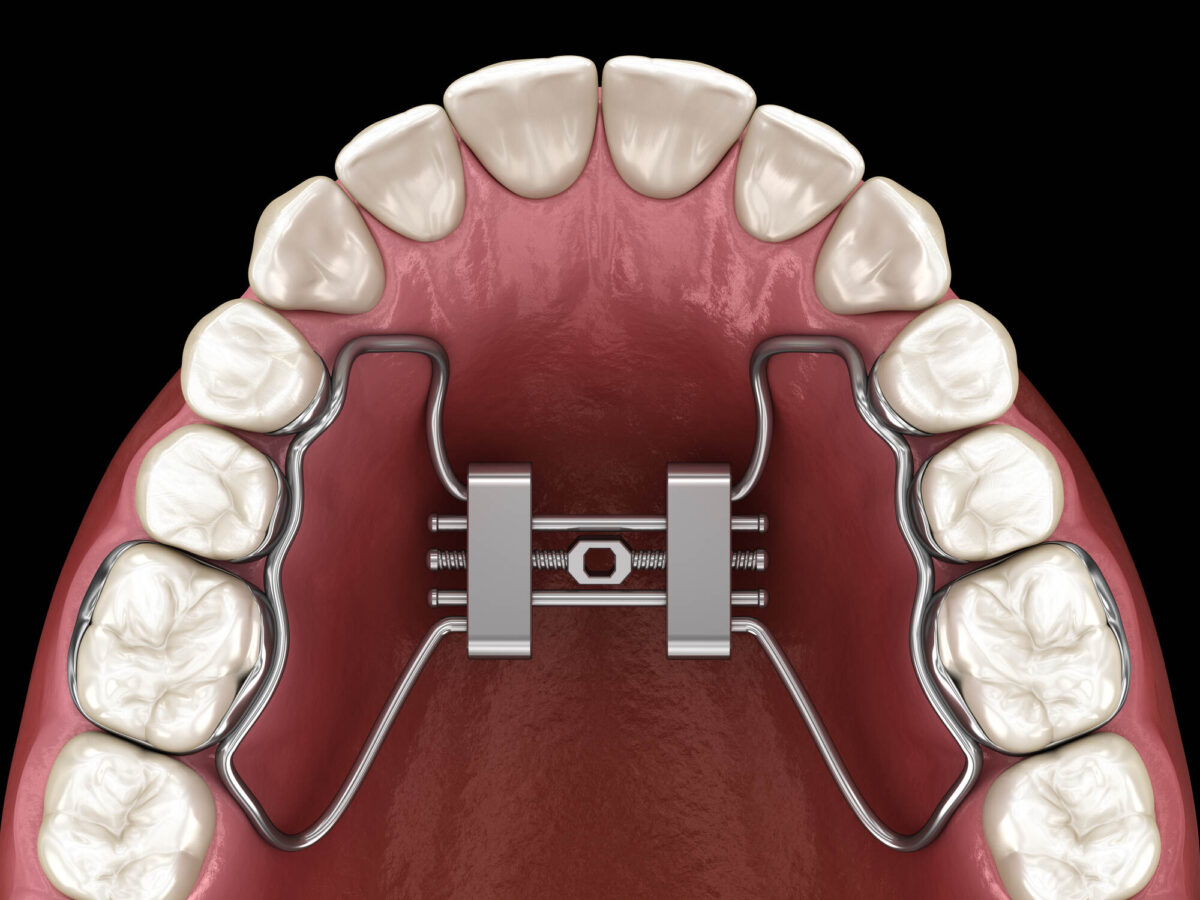
A palatal expander is a small appliance fixed to the upper back teeth that widens a narrow upper jaw, a fraction of a millimeter at a time. It does not straighten teeth. It builds the space that straight teeth need, and it does that by broadening the bone itself rather than by tipping teeth outward. That distinction is the whole reason the timing matters.
At Marlo A. Miller, DDS, MS Orthodontics, known as For Your Grin, we offer palatal expanders in Yukon, Oklahoma, and we see families from across Yukon and West Oklahoma City. This guide covers what an expander does, the signs that point to one, what the research says about breathing and sleep, and how long the appliance stays in. Dr. Miller is a Diplomate of the American Board of Orthodontics and has practiced at 816 S Mustang Rd since November 2007.
Key Takeaways
- A palatal expander is a small appliance fixed across the roof of the mouth that widens a narrow upper jaw a fraction at a time.
- It works best while a child is still growing. The American Association of Orthodontists says expanders are most commonly used for growing children and young teenagers.
- Widening the palate does two jobs at once. It makes room for crowded teeth, and it increases airway volume.
- In a pooled analysis of 94 children, breathing pauses fell from 8.5 to 3.2 an hour, a 73 percent improvement.
- Snoring, mouth breathing, night terrors and bed-wetting are worth raising at an evaluation. Call Marlo A. Miller, DDS, MS Orthodontics in Yukon at 405-577-6453. Every patient gets a personal plan, and results vary from person to person.
What is a palatal expander, and how does it work?
A palatal expander is a fixed appliance that sits across the palate and attaches to the upper back teeth. The American Association of Orthodontists describes it plainly: the device “sits across the roof of the mouth, also known as the palate and is attached to the upper back teeth.”
The upper jaw is not one solid piece in childhood. It is two halves joined down the middle by a seam of cartilage and connective tissue. An expander applies steady outward pressure to that seam, and the two halves separate by a very small amount. New bone fills the gap. The jaw ends up genuinely wider, not just pushed around.
Your orthodontist gives you an adjustment schedule, usually a key turned once or twice a day at home. The AAO puts the sequence this way: “A palatal expander works in phases. First, your orthodontist places the expander and provides an adjustment schedule.” Active turning is the short part. Holding the new width while bone fills in is the long part.
This is why the growth window matters so much. In a child, that seam is still pliable and the appliance can move bone. In an adult it has fused, and pushing on it moves teeth instead. The AAO is direct about it: “A palate expander is most commonly used to treat growing children and young teenagers.”
Signs your child may need a palatal expander
The clearest sign is a crossbite, where the upper back teeth bite inside the lower ones instead of outside them. That is a width problem, and widening is the fix. Crossbite is one of the conditions we treat, along with crowding, deep overbite, underbite, open bite and spacing problems.
Crowding is the second common trigger. When permanent teeth have nowhere to erupt, they come in rotated, blocked out, or not at all. The AAO notes that “palatal expanders increase the width of the jaw to improve the space available for erupting permanent teeth,” and that “appropriate use of expansion therapy can help, in some cases, avoid tooth extraction.”
Our own page on airway orthodontics and palatal expanders puts the benefit the same way. Expansion “supports optimal jaw development, alleviates crowding, and can reduce the need for tooth extractions.”
Then there is a third group of signs that parents rarely connect to orthodontics at all. Snoring. Mouth breathing. Night terrors and sleepwalking. Bed-wetting past the age you expected it to stop. A child who sleeps ten hours and still wakes up tired, or who struggles with attention at school. These are worth raising, because a narrow upper jaw sits directly underneath a narrow nasal floor.
Age seven is the checkpoint. The AAO’s Consumer Awareness Program encourages parents “to take their children to see an orthodontist by age seven,” and its guidance says outright that “your child may be a good candidate for palatal expansion, which can widen the upper jaw and help reduce crowding in abnormally narrow arches.” We wrote separately about what an early orthodontic evaluation at age seven actually looks like.
How a palatal expander affects breathing and sleep
Widening the palate widens the floor of the nose above it. That is not a side effect, it is anatomy. As our airway page states, expanders work “by broadening the palate, which not only enhances dental alignment but also increases airway volume.”
The research backs the connection with numbers. A systematic review and meta-analysis published in Sleep Science in 2020 pooled seven studies covering 94 children, mean age 6.4 years, who had rapid maxillary expansion for obstructive sleep apnea. It measured the apnea-hypopnea index, the count of breathing pauses per hour of sleep.
Sleep study results
Apnea-hypopnea index before and after expansion
Breathing pauses per hour of sleep in 94 children, mean age 6.4 years, pooled across seven studies. Two follow-up groups.
Source: Bahammam, Sleep Science 13(1), 2020, a systematic review and meta-analysis of rapid maxillary expansion in children. Events per hour. Individual results vary.
In children followed for up to three years, the index fell from 8.46 to 3.2 events per hour, which the review reports as a “73% enhancement in the apnea hypopnea index.” In children followed for longer than three years it fell from 12.05 to 2.6, a 77 percent improvement. The full analysis is open access.
Two honest caveats. Ninety-four children is a modest pool, and expansion is not a treatment for sleep apnea on its own. Diagnosis belongs to a physician, and some children need tonsils and adenoids addressed as well. Our airway page describes exactly that kind of case: two patients whose enlarged adenoids and tonsils were removed on Dr. Miller’s and an ENT’s joint recommendation, with minor upper and lower expansion alongside it. Both reported sleeping better afterward.
What expansion does reliably is remove one physical restriction. If your child breathes through their mouth most of the day, that is a signal worth following up. We covered the causes and consequences of mouth breathing in children in more detail.
How long does a palatal expander take?
Timing is set per patient, and the AAO declines to give a single number for good reason: “Timing varies by patient and treatment plan. Some expanders are adjusted over weeks, then held in place longer so the jaw can stabilize.”
Two phases, and the second is longer than parents expect. Turning the appliance takes weeks. Leaving it in place afterward, doing nothing visible while new bone hardens across the seam, takes months. Remove it early and the jaw narrows back toward where it started. The waiting is the treatment.
Expect some pressure behind the nose in the first days, a gap opening between the front teeth, and a few days of talking and eating around the appliance. The gap usually closes on its own as fibers pull the teeth back together. Your specific schedule comes from Dr. Miller after imaging, not from an article.
If an expander comes loose partway through, that is on our list of orthodontic situations to call about. It is not an emergency in the painful sense. It does need a prompt appointment, because an expander that is not seated is not expanding.
Do palatal expanders work for adults?
Conventional expanders are designed for a jaw that is still growing, which is why the AAO frames them around children and young teenagers. In an adult, the midpalatal seam has fused. The same appliance pushing on fused bone tends to tip teeth rather than widen the jaw.
That does not mean an adult with a narrow arch or a crossbite has no options. It means the assessment comes first and the appliance second. Our approach is holistic and airway-centric, weighing facial aesthetics, bone structure, soft tissue support, airway function and the temporomandibular joints, not just the front teeth. If more information is needed, we image the jaw with an i-CAT v17 CBCT scanner, which captures the teeth and underlying jaw structure in three dimensions.
For adults whose concern is alignment rather than width, we offer traditional metal braces, Clarity ceramic braces and Incognito hidden braces, and uSmile clear aligners. Come in and ask. A consultation is the only way to find out which of those, if any, is the right answer for your bite.
What treatment looks like at For Your Grin in Yukon
You do not need a referral from your dentist. As our site says, you may get one, but it is not necessary.
The first visit starts with a short introductory video in the exam room. Dr. Miller then reviews health history and your main concerns, does a brief visual exam of the teeth, bite and jaws, and takes diagnostic records or schedules them. You come back about two weeks later for a consultation covering both the treatment plan and the financial plan. Nobody fits an appliance on day one.
On cost: insurance plans differ in how much they cover for orthodontic treatment, and we help you find out your coverage and build a plan for the balance. CareCredit is accepted for patients who want low-interest financing. We do not publish fees, because the plan depends on what the exam finds.
Bring your insurance card. Download and print the new patient forms in advance, or arrive fifteen minutes early to fill them out here. There are two waiting areas and a game room, so the wait is easier on everyone.
Our office is at 816 S Mustang Rd in Yukon, just off Route 4 between Smile Arts Dental and Village Center Pediatrics West. We are open Monday through Thursday, 8:00 AM to 4:00 PM, and Friday mornings from 8:00 AM to 12:00 PM for emergency appointments. Call 405-577-6453 or request an appointment. If we miss your call, you get a text back within minutes.
Frequently Asked Questions
What does a palatal expander actually do?
It widens a narrow upper jaw. The appliance attaches to the upper back teeth and applies steady outward pressure to the seam running down the middle of the palate, so the two halves separate slightly and new bone fills the gap. The result is a genuinely wider jaw, which makes room for crowded teeth and increases airway volume above it.
What age is best for a palatal expander?
While the child is still growing. The American Association of Orthodontists says a palate expander “is most commonly used to treat growing children and young teenagers,” and recommends a first orthodontic check-up by age seven, when a narrow arch can be spotted before permanent teeth are blocked out.
Can a palatal expander help my child stop snoring?
It can help, though it is not a standalone treatment for sleep apnea. A 2020 meta-analysis in Sleep Science of 94 children found breathing pauses dropped from 8.46 to 3.2 per hour, a 73 percent improvement, after rapid maxillary expansion. Diagnosis of sleep apnea belongs to a physician, and some children also need tonsils and adenoids addressed.
Does a palatal expander hurt?
Most children report pressure rather than pain, strongest in the first few days and after each turn. Talking and eating feel odd for a short while. A gap often opens between the front teeth, which is a sign the appliance is working and usually closes on its own.
How long does my child have to wear the expander?
Active turning takes weeks. The appliance then stays in place for months without adjustment while new bone hardens across the seam. As the AAO puts it, “some expanders are adjusted over weeks, then held in place longer so the jaw can stabilize.” Removing it early lets the jaw narrow back.
Do palatal expanders work on adults?
Conventional expanders are built for a growing jaw, and in adults the seam down the middle of the palate has fused. An adult with a narrow arch or a crossbite still has options, but the assessment comes first. Book a consultation in Yukon and we will image the jaw and tell you what is realistic for your bite.
Reviewed by Marlo A. Miller, D.D.S., M.S., Diplomate of the American Board of Orthodontics, Marlo A. Miller, DDS, MS Orthodontics, 816 S Mustang Rd, Yukon, OK 73099. This article is general information, not a diagnosis. Every patient gets a personal plan, and results vary from person to person.